7 min Read
From Brand Strategy to Local Action: Building a More Agile Local Marketing Model
Give Every Location the Agility to Act on What Matters Locally
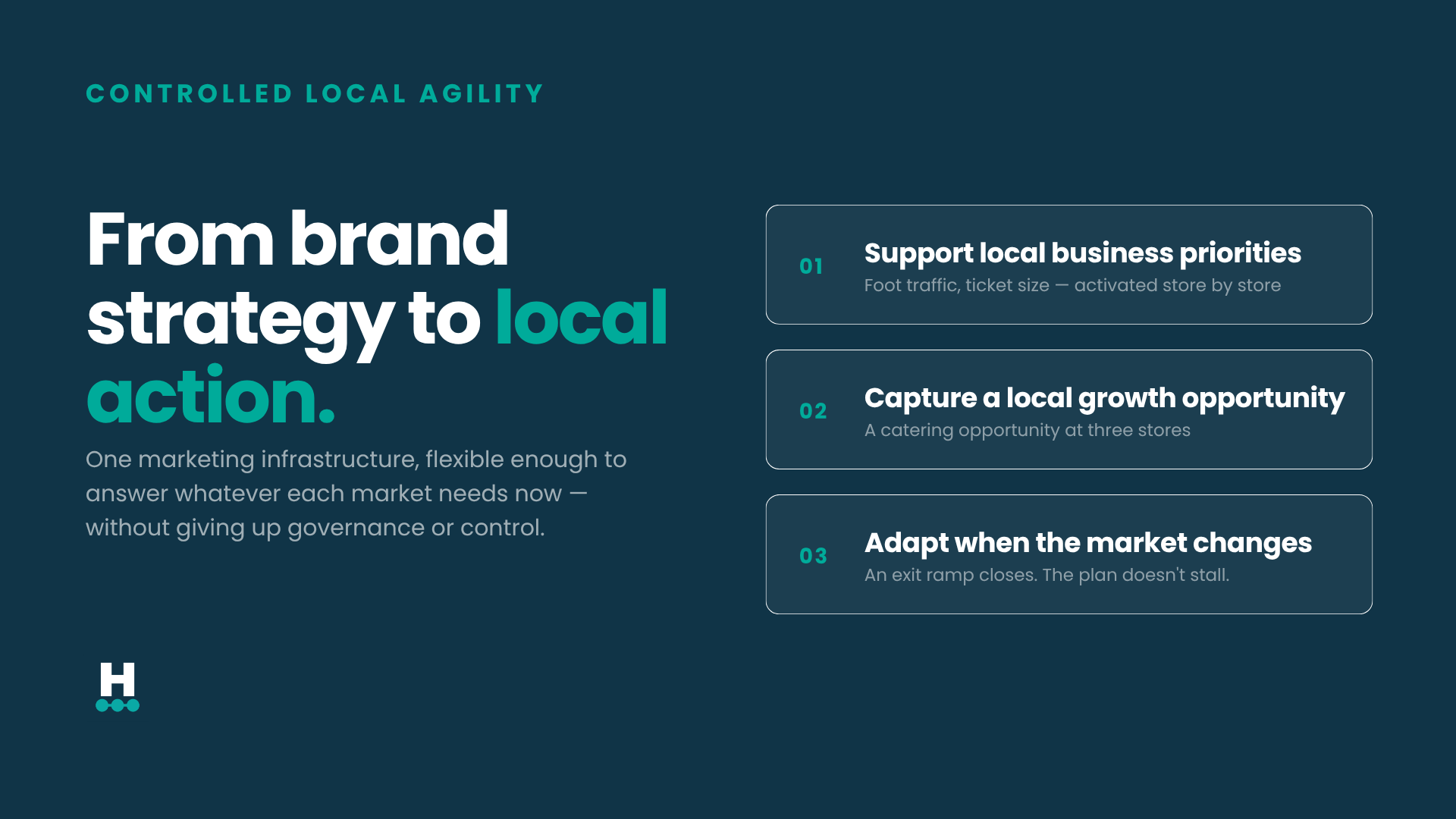
Local priorities don’t always align neatly with the national marketing calendar. From recruiting and catering growth to sudden changes in traffic patterns, an AI-powered local marketing platform gives multi-location brands the agility to act on what’s happening in each market—without sacrificing corporate strategy, governance, or control.
Local Markets Move Fast. Marketing Needs to Keep Up.
Enterprise marketing teams are built to run large campaigns well. But across hundreds or thousands of locations, new priorities emerge every day:
- A few stores need help recruiting.
- A market sees an opportunity to grow catering.
- A competitor opens nearby.
- Construction changes how customers reach a location.
- A franchisee sees a growth opportunity unique to their trade area.
These aren’t necessarily small opportunities. They’re specific local opportunities—and traditional marketing operations aren’t always designed to respond to each one individually.
A campaign for one or a handful of locations can require many of the same steps as a national initiative: creative, targeting, budgets, setup, approvals, and measurement.
Sometimes that makes a highly localized campaign difficult to justify through a traditional agency model. Other times, the opportunity is simply moving faster than the campaign-development process can support.
The opportunity: Give local markets more flexibility to act without creating more work—or less control—for the corporate marketing team.
AI-powered local marketing infrastructure makes that possible by establishing strategy, guardrails, data, creative, and channel capabilities centrally, then applying them against changing local priorities.
What does that look like in practice?
Three very different local priorities. One flexible marketing infrastructure.
01 | Recruit Where the Need Exists
The priority: Fill open roles at three specific locations.
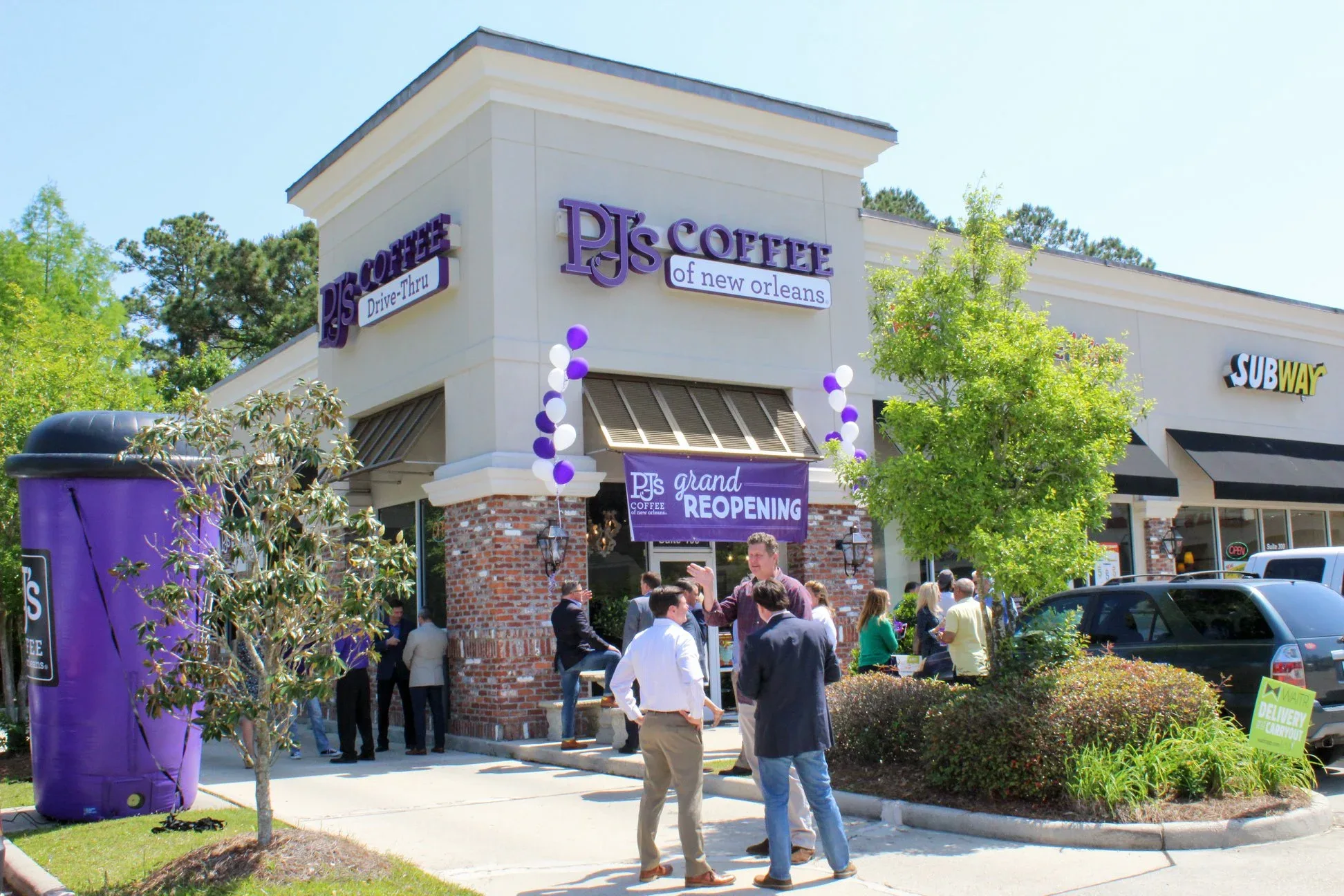
A national coffeehouse brand with hundreds of locations needed Shift Leaders and Team Members at three stores.
It wasn’t a national recruiting initiative. But for those three operators, it was an immediate business priority.
Instead of requiring the internal marketing team to build each campaign manually, each location received a targeted recruiting campaign with creative, budget, and geography calibrated to its local market.
The outcome:
340 applicants
across three locations
16 confirmed hires
with additional hires in progress
51 Shift Leader + 289 Team Member applicants
Local flexibility means marketing can support the business priority that matters now—even when it falls outside the national campaign calendar.
02 | Capture a Market-Specific Growth Opportunity
The priority: Grow two distinct catering occasions.
For a national restaurant brand with hundreds of locations, the opportunity was catering—specifically Office Catering and Catering at Home.
Different occasions. Different audiences. Different needs.
A program this specific can be difficult to justify through a traditional agency model, particularly when it only applies to certain markets or locations.
With local marketing infrastructure already in place, the brand could establish the strategy centrally and activate the appropriate audiences and messaging where the opportunity existed.
The outcome: 600+ catering orders generated in the first week.
The bigger takeaway isn’t simply campaign performance.
It’s that more market-specific growth opportunities become actionable when the cost and complexity of activating them are no longer the limiting factors.
03 | Adapt When the Market Changes Overnight
The priority: Respond to an unexpected change in customer traffic.
A California franchisee of a national QSR brand is facing a very different local challenge:
The highway exit ramp that typically brings customers toward his restaurant is closed for several weeks.
Nothing about the restaurant changed.
But its market did.
When traffic patterns change overnight, so can the flow of customers through your doors.
The franchisee could wait it out. Or the brand can adapt.
With intelligent local marketing infrastructure already in place, the response could include:
- Digital out-of-home around relevant alternate traffic patterns
- Performance Max to reach customers who may no longer be approaching from the interstate exit
- Location-specific targeting based on the new customer journey
- Brand-approved creative and budgets already governed within the platform
The local situation changed. The entire marketing process doesn’t have to.
That’s local agility: responding to what’s happening around an individual location while operating within the strategy and guardrails of a national brand.
One Infrastructure. Many Local Priorities.
Recruiting, catering, and a highway closure are very different business challenges.
But the marketing infrastructure required to respond to them is remarkably similar.
Local Intelligence
Understand the market around each location and use that context to inform activation.
Brand-to-Local Guardrails
Give locations flexibility while keeping creative, messaging, budgets, and execution within corporate parameters.
AI-Powered Execution
Translate a local business priority into targeting, budgets, creative, and campaigns without rebuilding everything manually.
Centralized where control matters. Flexible where local relevance matters.
That’s the operating model. Not uncontrolled local marketing. Controlled local agility.
From Brand Strategy to Local Action
Across a large multi-location organization, local priorities are constantly emerging.
Some are planned. Others aren’t.
Some apply to hundreds of locations. Others may matter deeply to only one.
No corporate marketing team can anticipate every one of those moments in an annual marketing calendar—and they shouldn’t have to.
The opportunity is to build marketing infrastructure capable of responding when those moments happen.
Instead of asking:
“Is this campaign large enough to justify the resources required to build it?”
Brands can ask:
“Is there a local business priority worth acting on?”
An AI-powered local marketing platform connects brand strategy to local action—giving multi-location organizations the agility to respond to more markets, more priorities, and more growth opportunities while maintaining the governance and consistency the brand requires.
See how per-location advertising works →
About Hyperlocology
Hyperlocology is the local marketing platform for franchise and multi-location brands. By combining AI-powered campaign creation, location intelligence, and brand-to-local governance, Hyperlocology helps marketing teams turn brand strategy into location-level action across digital channels and direct mail.
Learn more at hyperlocology.com.
Frequently Asked Questions
What is an AI-powered local marketing platform?
An AI-powered local marketing platform helps multi-location brands create, customize, launch, and manage marketing at the individual location level. It combines local market intelligence, brand guardrails, and AI-powered campaign creation so locations can respond to local priorities while corporate teams maintain control.
How does local marketing give franchise and multi-location brands more agility?
Local marketing infrastructure allows brands to establish strategy, creative, audiences, channels, budgets, and governance centrally, then adapt campaigns to individual markets. This makes it easier to respond to local opportunities—from recruiting and catering growth to competitive changes or traffic disruptions—without building every campaign from scratch.
Why are highly localized campaigns difficult for traditional agencies to support?
Campaigns for one or a handful of locations can require many of the same setup steps as much larger campaigns, including creative, targeting, budget allocation, approvals, activation, and measurement. That can make highly localized campaigns difficult to support cost-effectively through a traditional agency model.
How can AI help brands respond to changing local market conditions?
AI can reduce the manual work required to turn a local business need into an executable campaign. Combined with location-level data and predefined brand guardrails, AI-powered local marketing can help brands adjust targeting, geography, creative, budgets, and channel activation when local conditions change.
How do multi-location brands balance local marketing flexibility with brand control?
Corporate teams can centrally define approved creative, messaging, audiences, channels, budgets, and other campaign parameters while allowing execution to adapt by location. This gives local teams more flexibility to address market-specific priorities without sacrificing brand consistency or corporate governance.
Resources
Start running smarter local campaigns today.
Let’s show you how Hyperlocology powers performance at every location.