6 min Read
Your Franchisees Already Have Local Prices. Why Don’t Their Ads?
Written by Kayla Housewright, Senior Customer Growth Manager at Hyperlocology
Franchisees already operate in different cost environments. Local campaigns should too — without sacrificing brand control.
I spend most of my days working with franchise marketing teams at QSR brands — and this is a common challenge that, when done right, has a measurable impact on incremental sales.
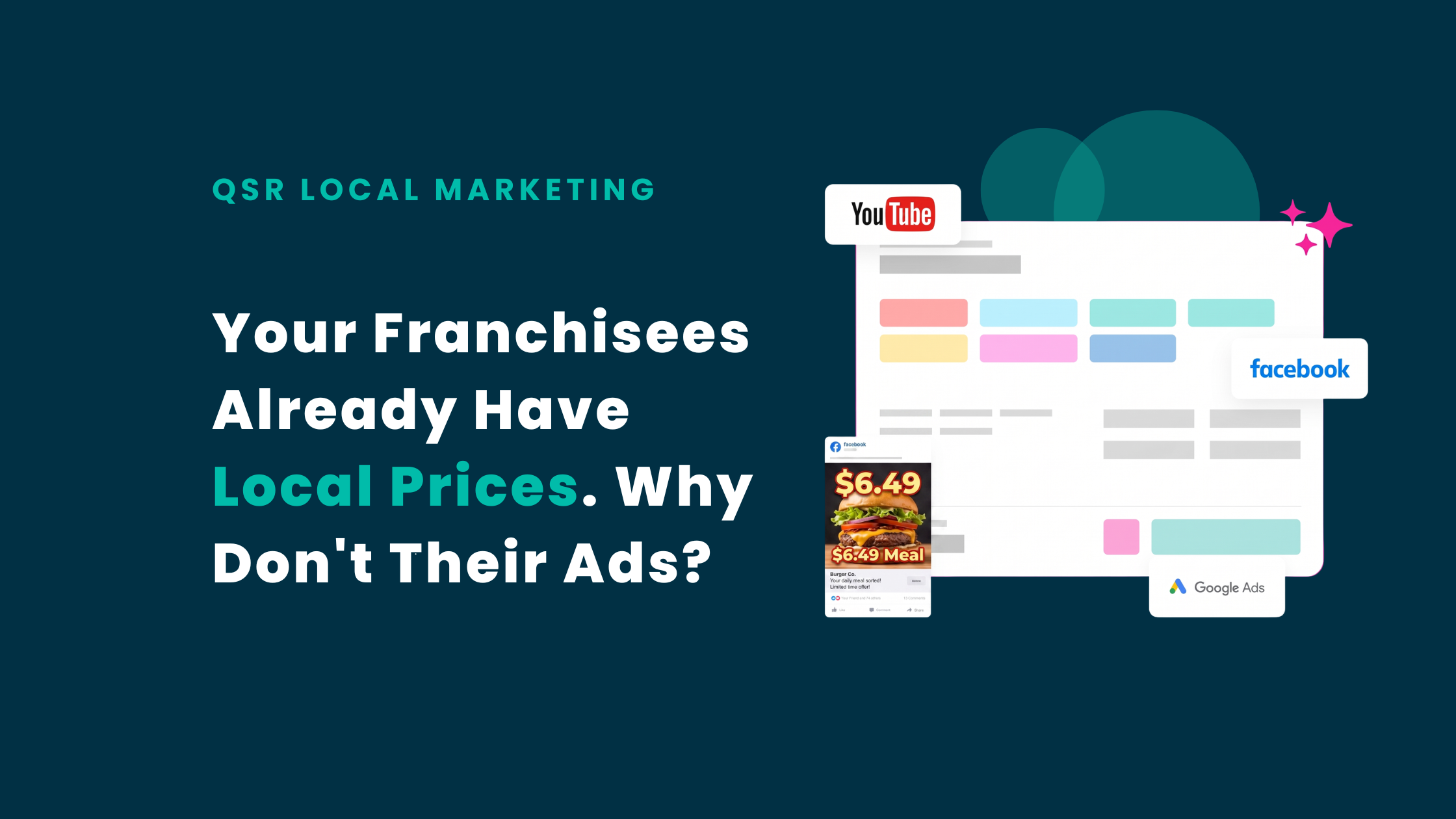
Franchisees who can adjust national offers to local market conditions outperform those who can’t. That part, everyone agrees on. A national $5 promotion becomes $6.49 in a higher-cost trade area. Same campaign creative. Same brand message. Different price point — because the operator knows their market.
What nobody can agree on is whose job it is to fix it.
The Gap Between Your Tech Stack and Your Marketing Stack
Price variation already runs through your core systems. The POS handles it. The loyalty app handles it. Delivery platforms handle it. Regional pricing is table stakes at the brand level — any multi-unit QSR operator running hundreds or thousands of locations has long since built the infrastructure to accommodate it.
But step outside those systems and into local store marketing, and that same flexibility disappears. Franchisees get a fixed offer, a one-size-fits-all campaign, and a single price point baked into the creative — and then the brand wonders why local activation rates are low.
The operator in a dense urban market knows their guests are less price-sensitive. The operator in a suburb with three competitors inside a mile knows they need to lead with value. Neither of them can act on that knowledge inside a static national campaign.
So they don’t run ads at all. Or they go rogue. In my experience, neither outcome surprises the brand — but both keep happening anyway.
Why “Brand Consistency” Gets Used as an Excuse
The reflex I see most often at franchise marketing teams is to lock creative down in the name of brand consistency — and that reflex isn’t wrong. Brand integrity matters. An operator swapping in an off-brand font or promoting a discontinued item is a real problem.
But price-point flexibility and brand consistency aren’t in conflict. They only feel that way when the tooling forces a binary choice.
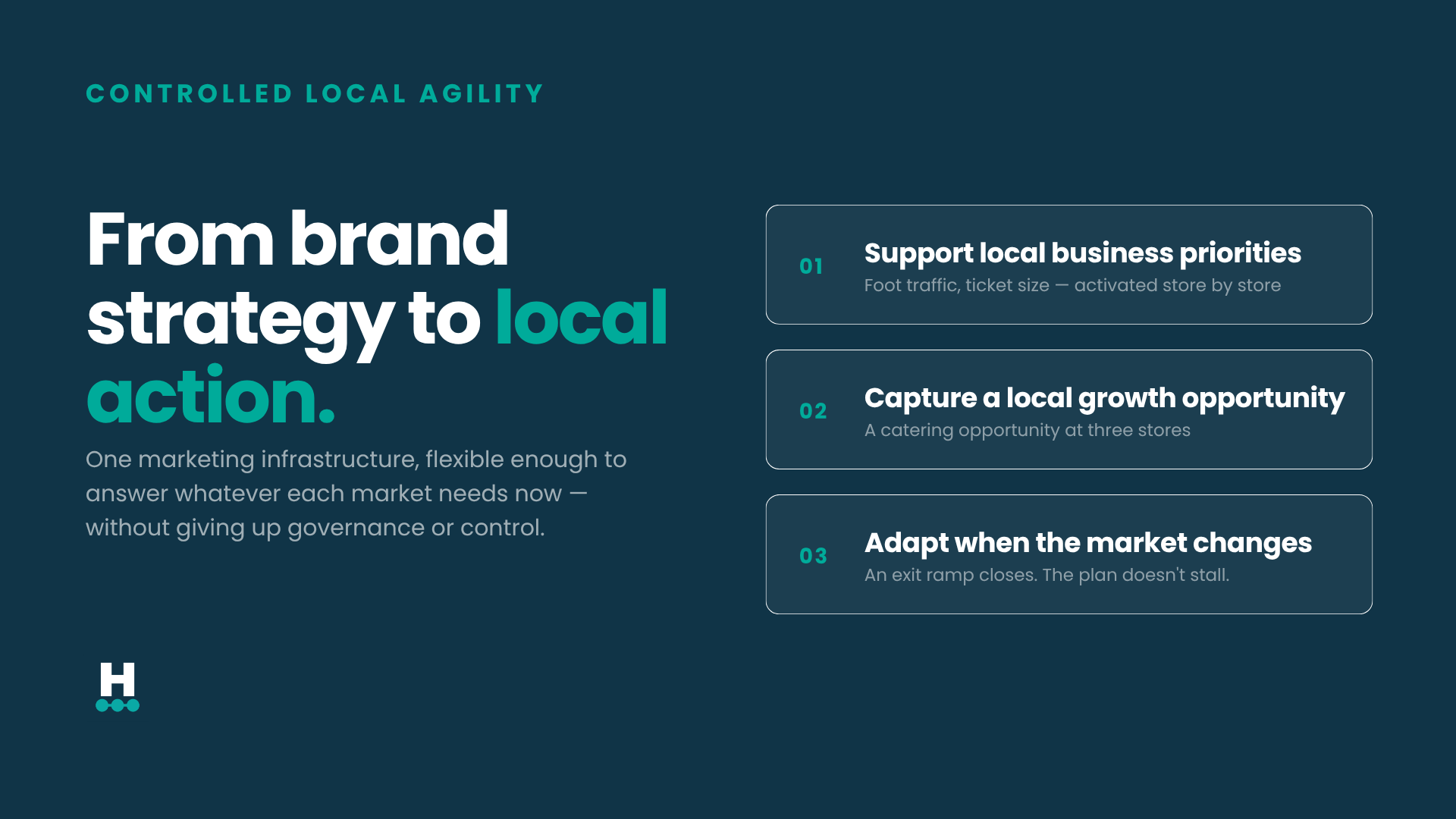
When local marketing infrastructure is built for variation — the same way the rest of the tech stack is — franchisees can adjust what needs to adjust (offer price, timing, trade area) while everything that shouldn’t move stays locked (logo, messaging, channel mix, campaign structure). Brand control and local relevance coexist because the system is designed to hold both.
Without that infrastructure, I watch brands choose between two bad options: lock everything down and watch local activation rates stagnate, or open everything up and watch compliance erode. Neither is a strategy.
What “Built for Variation” Actually Looks Like
The brands getting this right aren’t giving franchisees free rein. They’re giving them the right options.
Creative that localizes without going off-brand. Brand-approved creative templates let operators select an approved offer price or localized call to action without touching the creative itself. The design is always on-brand. The offer is always market-relevant. Those two things aren’t in tension when the template is built correctly.
Timing and availability that operators can control — within guardrails. A national promotion that runs from the 1st through the 15th makes sense for the brand calendar. Whether an operator pushes harder in week one because a competitor just opened nearby — or extends into week three because their local event calendar lines up — that’s the kind of flexibility that drives actual participation. The brand sets the window. The operator decides how to use it.
Geo-targeted execution that connects the offer to the right audience. A price-adjusted offer means nothing if it’s being served to the wrong trade area. Local campaigns need to reach the specific zip codes, radius, or delivery zones that the operator actually serves — not a DMA-level approximation. When geo-targeting is built into the campaign infrastructure, operators can run market-appropriate offers to market-appropriate audiences, and the brand can see exactly where campaigns ran and what they drove.
Reporting that closes the loop. Operators can’t optimize what they can’t see. Brands can’t scale what they can’t measure. When local campaign performance rolls up — by location, by market tier, by offer type — both sides of the franchise relationship get smarter. The brand learns which price points perform in which trade area types. The operator learns whether local advertising is actually driving incremental traffic.
This is the infrastructure I help QSR brands deploy through Hyperlocology. Our platform connects to the systems brands already use — for targeting, for media execution, for reporting — and sits on top of them as the local marketing layer. Franchisees get a managed experience where flexibility is possible without chaos. Brands get visibility and compliance without manual enforcement.
The Activation Problem Is an Infrastructure Problem
Here’s the number I come back to in almost every onboarding conversation: fewer than 5% of enterprise franchise locations actively run local store advertising in any given month without the right tech partner in place.
That number isn’t a reflection of franchisee disinterest. Every operator I’ve talked to wants to drive traffic. They want to promote locally. What they don’t want is a process that’s complicated, time-consuming, and disconnected from how their business actually works.
When local marketing is hard — when it requires negotiating with agencies, producing custom creative, managing media buys manually, and reconciling disconnected reporting — most operators opt out. Not because they don’t see the value, but because the cost-to-effort ratio doesn’t make sense at the location level.
When it’s easy — when an operator can launch a geo-targeted, brand-approved campaign with a locally relevant offer in a few clicks, and see results in the same dashboard they already use — participation goes up. Measurably.
The Question I Keep Asking
How much pricing flexibility do you give franchisees on local campaigns right now — and what would change if you had the infrastructure to make more flexibility safe?
Most brands I work with aren’t philosophically opposed to local price variation. They’re operationally unprepared for it. There’s no system to hold the guardrails. No tooling to enforce compliance at scale. No reporting to understand what’s working.
That’s the gap Hyperlocology fills — and it’s the conversation I’m having with franchise marketing teams every day.
The brands winning at local aren’t choosing between brand consistency and franchisee flexibility. They’ve stopped treating those as competing priorities — and started building infrastructure that makes both possible at the same time.
See how Hyperlocology works for enterprise QSR systems → Get a Demo
Resources
Start running smarter local campaigns today.
Let’s show you how Hyperlocology powers performance at every location.