4 min Read
DMA Co-op Marketing Works — Until It Doesn’t
For franchise brands operating across multiple DMAs, co-op marketing has long been a cornerstone of local advertising strategy. Pool the budgets. Coordinate the message. Run the market-level campaign. It’s a model built on the logic that shared resources drive shared results.
And when one dominant operator controls the vote — and the vision — it works well. The brand speaks with one voice, spend is concentrated, and the market gets a coordinated push.
But most DMAs aren’t that clean.
When a market is fragmented across multiple independent operators with competing priorities and no clear majority, the co-op model starts to break down. And the fallout isn’t just strategic — it’s operational, financial, and relational.
The Hidden Cost of a Fractured Co-op
The promise of co-op marketing is efficiency. Pooled budgets buy more reach, and coordinated campaigns drive stronger brand presence than any single operator could achieve alone.
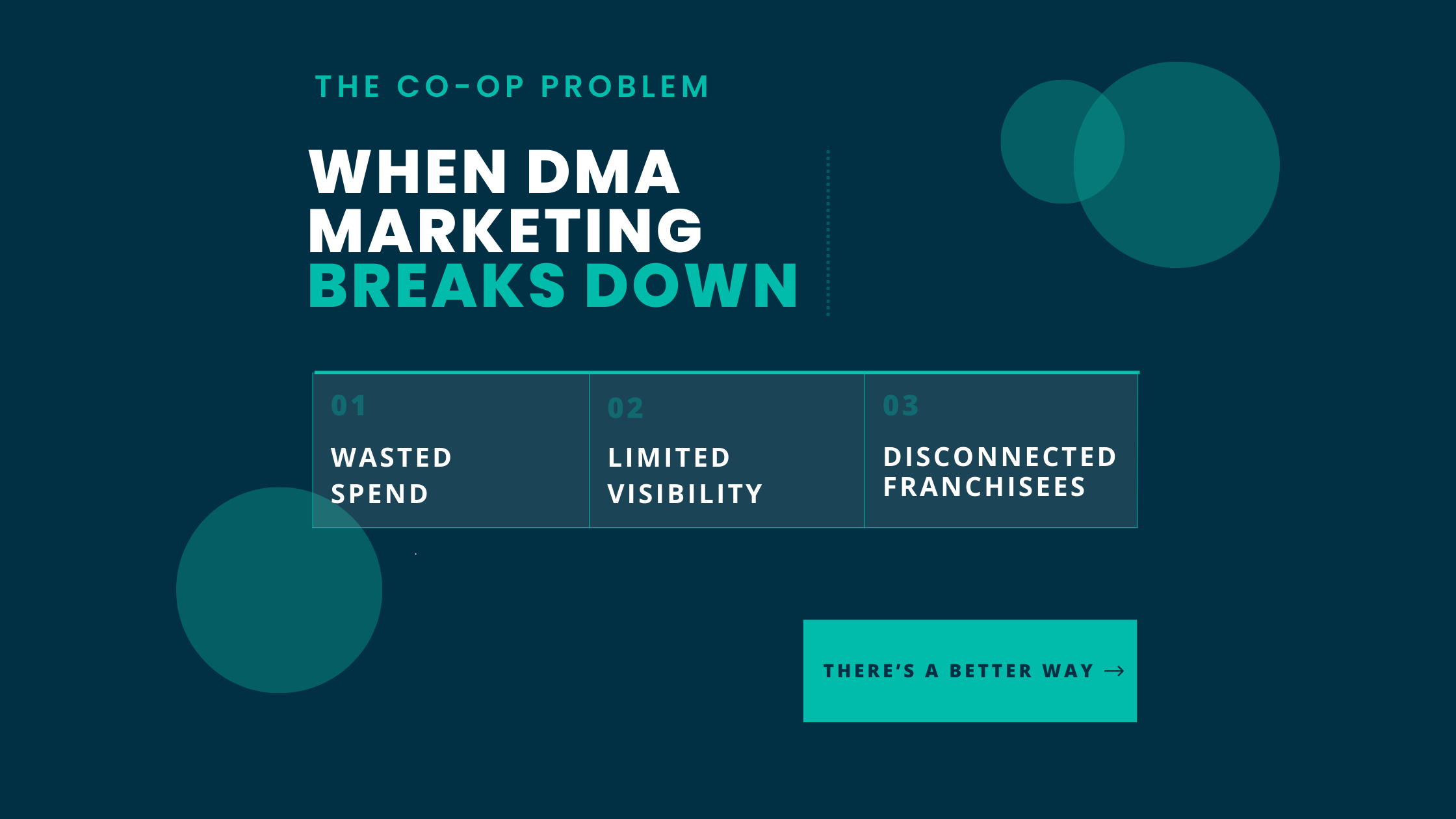
But in practice, fragmented DMAs create three persistent problems that erode those benefits:
- Wasted spend. When budgets are pooled without local accountability, it’s nearly impossible to know which dollars are actually driving performance. Operators fund campaigns they can’t evaluate.
- Limited local visibility. Market-level reporting tells you how the DMA is performing. It doesn’t tell you how your locations are performing. For individual operators making investment decisions, that’s a critical gap.
- Disconnected franchisees. When operators feel like they have no say in how their money is spent — and no way to see what it’s doing — trust erodes fast. Co-op assessments become a source of friction instead of a foundation for growth.
These aren’t edge cases. They’re the everyday reality for brand marketing teams managing co-op programs in competitive, multi-operator markets.
Why the Traditional Model Struggles to Keep Up
The co-op model was designed for a different era of local marketing — one where options were limited to broadcast media and regional buys, and where “efficiency” meant running the same spot in the same market for everyone.
Digital advertising has changed the equation entirely. Targeting is now granular enough to reach customers within a specific radius of a specific location. Reporting is real-time and attributable. Budgets can be optimized at the store level.
The infrastructure for truly localized, accountable marketing exists. But many franchise brands are still running co-op programs built on the old model — because the tools to do otherwise have been too complex or too fragmented to manage at scale.
That’s the gap AI-powered platforms are now closing.
What Smarter Co-op Marketing Actually Looks Like
Evolving the co-op model doesn’t mean abandoning it. The pooled efficiency of DMA-level spend still creates real value — especially for brand awareness and coordinated market presence. The goal is to preserve those benefits while adding the local accountability that fragmented markets require.
With the right platform, franchise brands can:
- Maintain DMA-level efficiency where scale drives value, without forcing every operator into the same one-size-fits-all plan.
- Enable localized budgets, targeting, and reporting so individual operators can see exactly how their investment is performing — and act on it.
- Preserve brand control with compliant, brand-approved creative and offers that don’t require a manual review process every time a local campaign goes live.
- Run pooled and localized strategies simultaneously within the same market — not as competing approaches, but as complementary ones.
The result is a co-op program that feels less like an assessment and more like a service — one that operators trust because they can see what it’s doing for their business.
From Co-op Politics to Brand-to-Local Collaboration
The franchisee relationship is built on a simple premise: the brand provides the system, the operator provides the local execution. Co-op marketing, at its best, is where those two things meet.
When operators feel seen in that relationship — when their local context is reflected in how campaigns are built and measured — they engage differently. They become advocates for the program instead of critics of the assessment.
That shift doesn’t happen by accident. It happens when brands invest in the infrastructure to make local accountability possible at scale.
How Hyperlocology Solves This
Hyperlocology was built specifically for the complexity of multi-unit franchise marketing. Our AI-powered platform enables brands to execute both pooled DMA strategies and localized operator campaigns within the same market — without sacrificing brand alignment or operational efficiency.
Brand teams get centralized control and visibility. Franchisees get transparent, location-level reporting and the ability to participate in their local marketing in a meaningful way. And AI handles the optimization work that would otherwise require hours of manual effort.
It’s not about replacing the co-op model. It’s about making it work the way it was always supposed to — for the brand and for every operator in the market.
Resources

Start running smarter local campaigns today.
Let’s show you how Hyperlocology powers performance at every location.